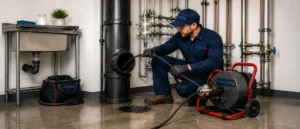

Kitchen stack cleaning in condo buildings is one of the most deferred maintenance tasks in high-rise property management — and one of the most consequential when ignored. Grease, food debris, and soap residue accumulate silently inside vertical drain stacks that serve dozens of units simultaneously. By the time a blockage becomes visible, the damage — and the cost — is already substantial.
What a Kitchen Stack Actually Does — and Why It Clogs?
A kitchen stack is the vertical drain pipe that runs floor-to-floor through a building, collecting wastewater from every suite’s kitchen sink along the way. In a 20-storey condo, a single stack may serve 40 to 60 kitchens — all funnelling grease, food particles, and detergent residue downward through the same column of pipe.
Think of it like a highway that narrows by a lane every few years. Individually, each layer of buildup is negligible. Collectively, over a decade of use without cleaning, those layers restrict flow to the point where any additional load — a grease-heavy holiday cooking season, for example — can trigger a backup that affects multiple floors at once.
Cast iron and PVC stacks, which are standard in high-rise residential construction, are particularly susceptible to grease adhesion. Unlike horizontal drain lines, vertical stacks rely on gravity rather than velocity to keep debris moving. When pipe walls accumulate enough buildup, that gravitational flow is compromised.
The Slow Damage Property Managers Don’t See Coming
Grease buildup in high-rise stacks tends to cause problems that are easy to misread. A slow-draining kitchen sink on the 14th floor looks like a unit-level issue. A recurring odour complaint in a corridor seems like a ventilation problem. A small backup that a plumber clears with a snake appears resolved — until it recurs three months later.
What these symptoms often share is a common source: progressive buildup in the kitchen drain stack that no amount of unit-level snaking will address. The blockage isn’t in the suite; it’s in the shared vertical stack running behind the walls.
Left unaddressed, this buildup creates three distinct liability categories for condo boards and property managers:
Water damage claims from backups that overflow into suites
Emergency response costs that far exceed the cost of scheduled maintenance
Accelerated pipe degradation, particularly in older cast iron stacks where grease acidity contributes to corrosion over time
The pattern is consistent: buildings that skip condo plumbing maintenance for several years don’t save money — they accumulate deferred costs that arrive all at once, usually during peak occupancy, and usually at emergency rates.
What Kitchen Stack Cleaning Involves
Professional kitchen stack cleaning uses high-pressure water jetting equipment — not chemical treatments or mechanical snakes — to cut through accumulated grease and restore full pipe diameter. A camera inspection before and after the clean confirms the extent of buildup and verifies that the line is clear.
In well-maintained buildings, this process is straightforward and efficient. In buildings where stack cleaning has been deferred for several years, the cleaning may uncover underlying pipe damage — hairline cracks, joint separations, or corrosion — that would otherwise go undetected until a failure occurs.
This is one reason camera inspection is built into Aquazen’s process. Cleaning without inspection is like servicing a car without checking the engine — the surface problem is addressed, but what’s developing underneath remains unknown.
How Aquazen Cleans Kitchen Stacks Without Disrupting Residents
Condo kitchen drain maintenance carries a coordination challenge that doesn’t exist in commercial or low-rise settings: access requires entry into occupied suites, and any disruption affects not one tenant but dozens.
Aquazen’s kitchen stack cleaning process is designed with this reality in mind. Where access points are not already in place, the team installs retrofit cleanouts that eliminate the need for drywall removal or repeated suite entry for future maintenance — no ugly access panels, no construction disruption. Work is sequenced floor-by-floor to minimize the window of service interruption, and residents are notified in advance with clear timelines.
The result is a completed clean with minimal disruption — which matters in buildings where the relationship between management and residents is an ongoing one.
[INTERNAL LINK: kitchen stack cleaning service page]
How Often Should a Kitchen Stack Be Cleaned?
There is no universal answer, but the practical standard for most high-rise residential buildings is every two to three years. Buildings with higher cooking intensity — those with a higher proportion of suites that cook frequently, or properties with ground-floor commercial kitchen tenants — may warrant annual cleaning.
The best starting point is a baseline camera inspection. A single run through the stack takes less than an hour and produces a clear picture of current buildup levels. From that baseline, a cleaning schedule can be set that reflects the building’s actual usage pattern rather than a generic industry recommendation.
Deferring beyond the appropriate interval doesn’t save money. It transfers costs forward with interest. A scheduled clean is a fraction of the cost of an emergency response — and neither figure accounts for the reputational impact a backup incident carries for a property management team.
Aquazen Services provides professional kitchen stack cleaning for high-rise residential and commercial properties across the Greater Toronto Area. If your building hasn’t had a stack inspection or clean in the past two years, contact us to schedule a free consultation — we’ll assess your current stack condition and recommend a maintenance interval that fits your building.